 China
 Thailand
 Vietnam
 Malaysia
 India
 Philippines
 Indonesia
 Australia
 New Zealand
 All Europe
 Morocco
 Egypt
 Canada
 USA
 Mexico

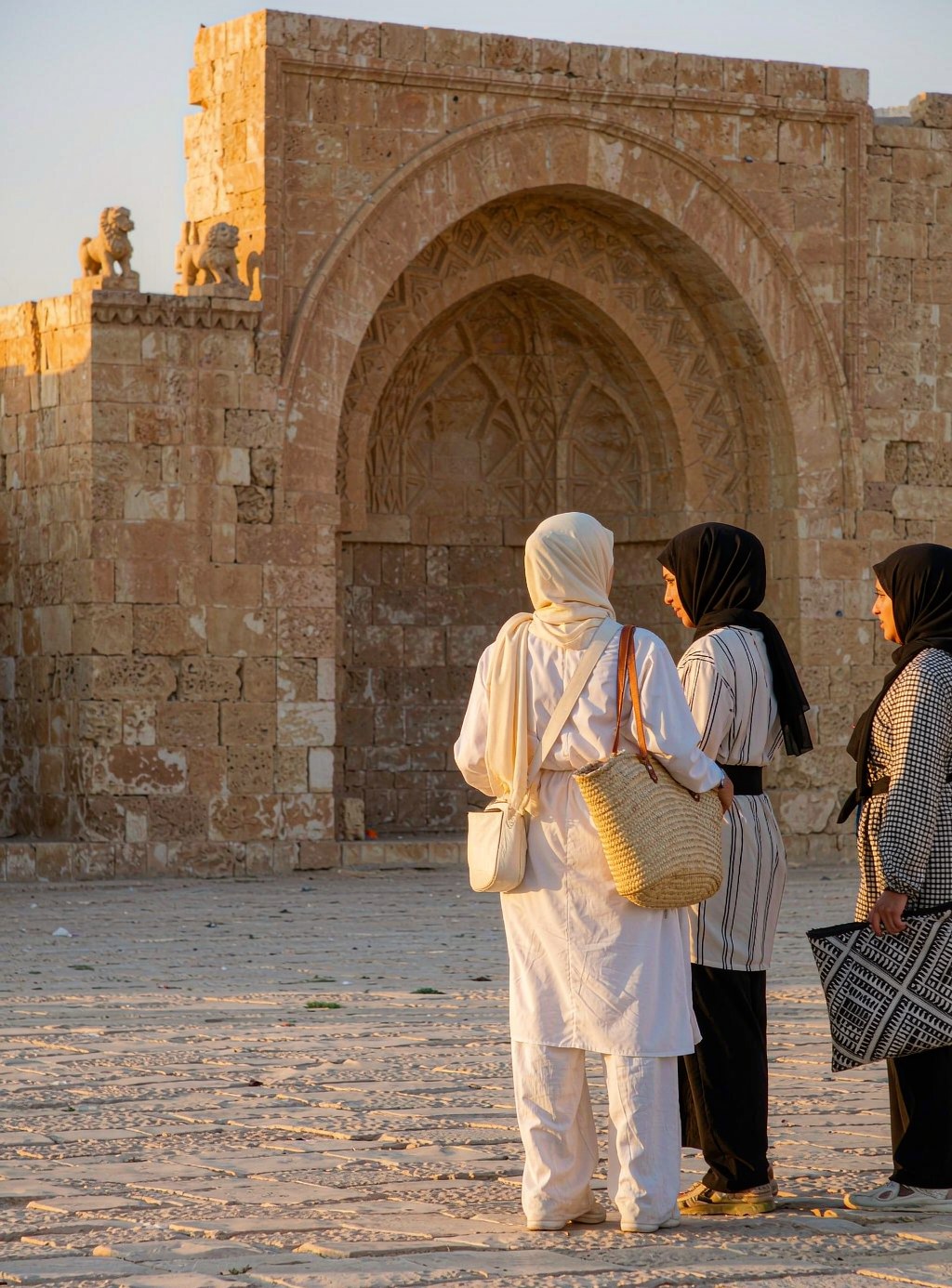
Halal Japan: how to eat, pray and travel well
Japan has a tiny Muslim population and a huge amount to offer Muslim travellers — if you arrive with a strategy. Halal food without stress, prayer rooms that actually exist, onsen questions answered, and a route that works.
Published 2026-11-17 · 21 min read
Japan is the destination Muslim travellers ask us about with the most excitement and the most anxiety, in roughly equal parts. The anxiety is about food. The excitement, once people have been, is about everything else: the trains that leave to the minute, the ryokan breakfasts, the temples at six in the morning before anyone arrives. Both feelings are reasonable, and this article is about settling the first so you can enjoy the second.
The short answer
Here it is up front: Japan is harder than Malaysia and easier than its reputation. You will not starve, you will find prayer space in every major city, and the country's famous hospitality works in your favour — a restaurant that cannot serve you will usually say so kindly and point you somewhere that can, rather than improvising an answer they are not sure about.
The reason for the difficulty is structural, not hostile. Muslims make up a tiny fraction of Japan's population, so halal is simply not part of the food system's default assumptions. Dashi, the stock at the base of much Japanese cooking, is usually fish-based — which is genuinely helpful — but soy sauces, mirin and cooking sake appear in nearly every simmered dish, and pork shows up in more places than newcomers expect: ramen broths, gyoza, tonkatsu crumbs, and as lard in some breads and fried rice.
The good news is that Japan rewards preparation better than almost any country. Everything is labelled, everything is online, everything runs on time, and the Muslim infrastructure — mosques, prayer rooms, certified restaurants, halal supermarket shelves — has grown enormously in the last decade and keeps growing. Travel with a strategy and the anxiety evaporates by day two.
Strategy one: certified and Muslim-owned restaurants
Your first strategy is the one that requires no thinking at meal times: eat at halal-certified or Muslim-owned restaurants, and build your sightseeing around where they are. There are now more of these than first-time visitors expect — in Tokyo well past a hundred, with solid clusters in Osaka, Kyoto and Kobe — and the quality has caught up with the quantity.
Certification matters here, and it is worth understanding the landscape. Several organisations certify in Japan, including the Japan Islamic Trust and the Japan Halal Association, and their standards and logos differ; Muslim-owned restaurants without formal certification are often run by observant owners and are where most Muslim residents actually eat. None of this is a reason for suspicion — it is a reason to look at a restaurant's explanation of what it does and decide if it matches your own standard. Japan's transparency makes that easy: halal-focused restaurants here almost always display a clear explanation, in English, of their sourcing.
The food itself is the surprise. Japanese halal cooking is not an imitation game: you can eat proper ramen with a rich chicken-based broth instead of pork, halal yakiniku where you grill wagyu yourself, halal-certified wagyu sukiyaki, and — in Asakusa, near Senso-ji — a long-running halal ramen shop that has become something of a pilgrimage site in its own right. Turkish-run doner kebab stands, a Tokyo lunchtime institution, are scattered through the business districts and reliably satisfy teenagers who have eaten rice three meals a day.
One booking note: the famous certified wagyu and sukiyaki places run small rooms and fill up days ahead. Book before you fly, not on the day.
Strategy two: seafood, vegetarian and teishoku
Your second strategy is the one that opens up the whole country: many ordinary Japanese restaurants can feed you well without any special arrangement, because large parts of Japanese cuisine never touch meat.
Teishoku set meals built around grilled fish — saba, salmon, sanma — with rice, miso soup and pickles are a national breakfast and lunch staple, and at a straightforward seafood restaurant or a market stall, fish is the entire menu. Sushi, for the careful eater, is one of the safest and best meals in Japan: nigiri of salmon, tuna, shrimp and egg involves nothing but fish, rice, wasabi and seaweed. The two things to avoid in an otherwise safe sushi order are the eggs-mixed-with-something items and anything dressed with a sauce, which is where mirin hides. Plain soy sauce, incidentally, is generally fermented without alcohol; seasoned or reduced soy sauces sometimes are not.
Zenzai and anko sweets, mochi, soba noodles (plain, not the tempura set), oden without the fish cakes if you can identify them, rice bowls topped with grilled fish or unagi — unagi is usually grilled with a sweet soy-mirin glaze, so treat it as a check-first item — the list of naturally suitable food is long and genuinely delicious.
The practical skill here is the calm phrase that unlocks everything: "Can you make it without meat, alcohol or mirin?" written in Japanese on your phone. Show it at the counter. In our experience, a restaurant that can say yes will be delighted to help, and one that cannot will say so immediately. Japan does not do improvised answers, which for a Muslim traveller is a feature.
Strategy three: supermarkets and konbini
The third strategy is the one that saves both money and mornings: self-catering from supermarkets and convenience stores, which every traveller in Japan uses anyway because the food is excellent.
Onigiri, the rice triangles that are the national quick meal, come in dozens of fillings and the safe ones are clearly identifiable once you know the words: salmon, umeboshi pickled plum, kombu kelp, and tuna mayonnaise (Japanese mayonnaise is typically egg-and-vinegar based without alcohol). Convenience-store eggs sandwiches, plain udon and soba, fruit, yoghurt and those famous egg sando from the bakery counter round out an easy day of eating for the price of one restaurant meal.
Larger supermarkets are better still. Big chains increasingly carry dedicated halal sections — frozen halal meat, halal curry roux, certified snacks — particularly in stores serving neighbourhoods with international residents. Ask at the counter; staff will walk you to the shelf. In Tokyo and Osaka, a couple of halal grocers stock everything from halal wagyu to certified instant ramen, and an apartment kitchen plus one shopping trip can feed a family for days.
The travel rhythm that works: certified restaurant for dinner (booked), seafood or teishoku lunch near wherever you are that day, konbini breakfast at the hotel. Nobody stresses, everybody eats well.
What to avoid at konbini level: instant noodles almost universally contain pork extract in the soup base; bakery items occasionally use shortening that is not plant-based; and desserts with jelly or mousse often contain gelatin. None of this requires paranoia — it requires the label habit, which the next section makes easy.
Reading labels without reading Japanese
Japanese food labelling is detailed, legally required, and readable with a translation app — this is the single biggest practical advantage over most non-Muslim countries. Ingredient lists are printed on everything, allergen and ingredient tables even appear on restaurant menus in chains, and a photo-translation app turns a package of mystery snacks into a readable list in seconds.
Learn to recognise a handful of words and you are equipped:
- 豚肉 (butaniku) — pork. Also watch for ポーク (pork) and lard written as ラード or listed as shortening (ショートニング).
- 酒 (sake), みりん (mirin), 料理酒 (ryorishu) — cooking alcohol. Mirin deserves special attention: it is in teriyaki glazes, simmered dishes, many sauces and most unagi.
- ゼラチン (zerachin) — gelatin, mostly in sweets, yoghurts and mousses.
- チキン・ビーフ (chicken / beef) — meat extracts appear in instant noodles and snacks as チキンエキス or ビーフエキス.
Screenshot this list. In practice you will use it less than you fear — plain seafood items and fresh fruit need no reading at all — but the one time a translation app settles a question at a konbini shelf, it pays for the whole trip's data plan.
A note on alcohol in cooking: opinion differs between scholars on whether sake or mirin fully transforms in cooking, and Muslim residents of Japan take different personal approaches. We are not going to adjudicate fiqh here. What matters for planning is that you know where it appears, so you can apply your own standard consistently instead of guessing dish by dish.
Where halal food actually clusters
Geography beats searching. Rather than hunting restaurant by restaurant, anchor your accommodation near the clusters and walk out of the hotel into halal options every evening.
Tokyo. Asakusa, near Senso-ji, is the friendliest single neighbourhood for Muslim visitors — several halal and Muslim-friendly restaurants within a few streets, plus shops carrying halal snacks. Ueno and Okachimachi have the densest concentration of South Asian halal restaurants in the city, with grocery stores alongside. Shinjuku and Shibuya are thinner on dedicated halal but rich in Turkish-run kebab shops and department stores with prayer rooms.
Osaka. Namba and the Dotonbori area have a handful of dedicated halal restaurants including halal yakiniku, and the Tsuruhashi district — Japan's Korea town — contains halal Korean barbecue options that are a genuine novelty. Osaka's main mosque sits in Ibaraki, a short ride north of the centre.
Kyoto. The thinnest of the big four, honestly, but manageable: a small set of Muslim-friendly restaurants near the station and downtown, and the city's superb vegetable cuisine — Kyoto's temple-derived shojin ryori tradition is vegetarian by design — gives careful eaters a dignified fallback. Kyoto rewards the supermarket strategy more than the others.
Kobe. Home of Japan's oldest mosque and a relaxed port-city food scene with Turkish and Indian kitchens within walking distance of the centre. If your route skips Kobe for sake of the wagyu alone, reconsider — the Kitano hillside plus a halal Kobe beef dinner is one of the trip's quiet highlights.
Prayer: mosques, musollahs and prayer rooms
Prayer infrastructure in Japan is small but well-placed, and it follows the traveller better than you would expect in a country with so few Muslims.
The anchor mosques: Tokyo Camii in Oyama-cho, Shibuya ward, is the largest mosque in Japan, a striking Ottoman-style building run with the Turkish community, with a halal cafe attached and Friday sermons that draw a genuinely international crowd. Kobe Mosque, built in 1935, is the oldest purpose-built mosque in the country and survived the war bombing that flattened much around it — standing inside it is worth the trip to Kobe on its own. Osaka's mosque in Ibaraki serves the Kansai community, and Nagoya and Fukuoka have active centres too.
The daily reality, though, is the musollah network: prayer rooms in airports — Narita, Haneda and Kansai all have them, clean and properly signed — and increasingly in large shopping centres and department stores, where the information desk will point you to one without blinking. Train stations are hit and miss; do not count on one, but count on the mall across the street. Hotel rooms, as everywhere, fill the gaps: a prayer mat in the suitcase solves most of a two-week trip by itself.
Two practical tips from experience. First, prayer room locations change quietly — a room that existed last year may have moved floors — so ask the desk rather than trusting a blog post, including this one. Second, Japan's mosques run on JST properly but small musollahs in shops keep variable schedules; if you need to pray with a group, Tokyo Camii's timetable is the reliable reference point.
Wudu, toilets and the little things
Japan's toilets are world-famous and, for once, the fame is deserved — heated seats, more buttons than an airplane cockpit. For wudu purposes they are also slightly awkward: the washlet is designed for a different purpose, and the floor-standing taps common in the Muslim world do not exist here.
The answer everyone arrives at within a day: carry a small bottle. A 500ml travel bottle in the daypack covers wudu in any toilet cubicle, and the airport and mosque prayer rooms have proper wudu areas so you can start the day clean and refresh as needed. This is the same packing list as the prayer-on-the-road kit anywhere else in the world, so nothing new is required — just the reminder that Japanese public bathrooms are immaculately clean and taking a bottle into a cubicle will bother no one.
Other small things that catch Muslim travellers specifically: shoes come off in many restaurants, temples and ryokan, so slip-ons beat laces; seating is often floor-based at noodle shops and izakaya, which for older knees is worth knowing in advance; and pockets matter — you will be holding shoes, coins, and a phone in various combinations all day. A small drawstring bag for shoes solves a daily annoyance for about a dollar.
A route that works
First-timers should not improvise a route. The classic Golden Route works, and it works for halal travellers specifically because it strings together every food cluster and every major mosque in the country:
- Tokyo, four nights. Asakusa for the old city and halal dinner options, Shibuya and Shinjuku for the modern side, Tokyo Camii for Friday prayer, one day out at Kamakura or Nikko.
- Hakone or the Fuji Five Lakes, one night. A ryokan night — see the onsen section below for doing this modestly — with Fuji weather permitting the trip's single best photograph.
- Kyoto, three nights. Temples at opening time before the crowds, Higashiyama's stone streets at dusk, the bamboo grove at Arashiyama early enough to hear it, and supermarket picnics in your apartment.
- Nara, day trip. The deer park and Todai-ji's great Buddha, half an hour from Kyoto, easy with children.
- Osaka, two nights. Dotonbori at night, halal yakiniku, Osaka's Ibaraki mosque for Jummah if the dates align, and either a Kobe day trip or the flight home from Kansai.
Twelve days, four cities, one onsen night, and every prayer has a known answer. Travellers with more time add Kanazawa (the best-preserved samurai district, quiet and superb) or Hiroshima, which deserves its sombre day and has a small but real Muslim community centre.
People worry about Japan's pacing — the sense that there is too much to see. The fix is subtraction, not speed: cut cities, not hours of sleep. Tokyo and Kyoto alone make a complete and satisfying trip if the alternative is a blur.
Trains, IC cards and luggage
Japan's trains are the reason the route above is relaxing rather than exhausting, but the ticketing decisions around them have changed recently enough that older advice is now wrong.
The headline: the national rail pass is no longer the automatic bargain it once was — its price rose sharply in 2023, and for the classic Tokyo–Kyoto–Osaka route it now only pays off in narrow circumstances. Run the actual numbers for your itinerary before buying; individual shinkansen tickets bought as you go are often cheaper, and regional passes sometimes beat both. This is a ten-minute calculation that saves real money, or better, ask whoever is booking your trip to do it.
What you definitely need is an IC card — the tap-and-go card for metro, buses and konbini. Physical cards can be obtained at airports, and phone-based versions load directly into a wallet app, which suits travellers who lose things. Charge it generously; it becomes the trip's most-used object.
Luggage rules on the shinkansen are the one genuine trap: bags exceeding a total dimension of about 160cm require an advance seat reservation with oversized baggage space, or a fee. Suitcases under that threshold are fine in the overhead racks. Ship the big bags instead — the forward-luggage service between hotels is inexpensive, famous, and turns every train ride into a light one.
And a small cultural joy worth scheduling: ekiben, the boxed meals sold on platforms, are a national institution. A konbini or platform bento of plain rice balls and grilled fish, eaten on a smooth train watching Fuji go by, is a halal-friendly travel memory people keep for decades.
Onsen, ryokan and modesty
The ryokan night is the trip's most memorable hotel experience — tatami rooms, futons laid at dinner, kaiseki-style meals, mountain air — and it is also where modesty questions concentrate, so let us settle them properly.
Public baths and onsen are gender-separated and bathing is nude; swimwear is not permitted in shared baths, which rules them out for most observant travellers, and tattoos remain widely prohibited in shared baths regardless. None of this closes the door. Virtually every ryokan offers kashikiri — private-bookable baths by the hour — and rooms with private open-air baths (a room-grade upgrade, not a luxury exaggeration in Japan's price structure) turn the onsen experience into a fully private one. Book the room grade with the private bath and you lose nothing: the rotenburo under the stars, mountain steam rising, is one of travel's great sensory experiences and it is entirely yours.
If the private bath is beyond budget, skip the bathing and keep the ryokan: the tatami room, the dinner, the breakfast tray and the garden are the experience as much as the water. Ryokan kitchens will also often accommodate dietary requests with advance notice — ask at booking, not at check-in.
Modesty beyond the bath: Japan is a place where covering up comfortably is easy. Summer is humid — light layers solve it — and there is no destination in the country where modest dress draws attention. Mosques provide changerooms and abaya-friendly facilities; the streets, honestly, are the easiest part.
Ramadan and Eid in Japan
Ramadan in 2027 falls in February, which coincidentally is one of Japan's loveliest travel months — clear, cold, photogenic — and fasting logistics in Japan are gentler than the distance-from-Makkah suggests.
February days are short; the fasting window in Tokyo is roughly from before 5:30 in the morning to about 5:20 in the evening, which is a manageable length compared to the fifteen-plus hours northern European Muslims endure. Suhoor is the easy meal — konbini rice balls and eggs in the apartment, or a pre-dawn convenience run — and iftar is the pleasant one: break the fast with dates from your daypack, then eat well at any of the clusters above. Taraweeh at Tokyo Camii during Ramadan is a genuine experience, the mosque full to the courtyard with dozens of nationalities, and community iftars pop up around the bigger mosques for travellers staying alone.
Eid in Tokyo and Osaka is joyfully chaotic — Tokyo Camii's Eid prayer overflows, Turkish and South Asian communities hold events, and halal restaurants run specials. If your trip dates can flex, travelling over Eid gives you Japan at its most communal for a Muslim visitor.
One caution for Ramadan travel specifically: Japan runs on time and does not slow down for anyone. Plan each day so that iftar falls somewhere you can actually eat — arriving hungry at a rural station at 5:25 in the evening is the avoidable mistake, not the unavoidable one.
Families, older parents and costs
Japan suits three generations better than almost anywhere, with one planning difference each.
Children love it immediately and unconditionally — trains, escalators that feel like rides, deer in Nara that bow for crackers, vending machines dispensing warm corn soup. The practical notes are the universal ones: apartments with kitchens beat hotel rooms for family eating budgets, and the konbini breakfast habit will save both money and morning arguments. Strollers are manageable but stations have more stairs than lifts than you would hope; a carrier beats a buggy under age three.
Older parents, likewise, thrive on the rail-based route — no long drives, spotless toilets everywhere, benches in every temple garden — with two adjustments: book the shinkansen's spacious seats (they exist on every train and cost little more), and pace Kyoto's temple hills with the honest admission that Higashiyama's slopes are slopes. Taxis in Japan are plentiful, spotless and reasonable for short hops; using them is not a failure of the rail plan, it is mercy.
Costs, at time of writing, run roughly like this for a mid-range standard: hotels ¥12,000–25,000 for a family room in the big cities, less in business-district stays; food from konbini and teishoku lunches keeps a family of four fed comfortably on ¥6,000–10,000 a day; the certified wagyu dinner runs whatever a certified wagyu dinner runs — worth it once. Japan is not cheap, but it is predictable, and predictability is what makes a halal trip restful. Prices move, so treat these as a shape for budgeting rather than a quote.
Souvenirs, gifts and what to bring home
Japan is the best gift-shopping country any of us have travelled in, and almost none of it is a problem for Muslim travellers — which is worth saying, because people worry about hidden alcohol in souvenirs the way they worry about it in food.
The safe and excellent list: ceramics, especially from Kyoto and Arita, where a single bowl can cost anything from a few hundred yen to a month's salary; stationery, which in Japan reaches a level of engineering that will ruin you for office supplies anywhere else; tenugui cloths, furoshiki wrapping squares and indigo textiles; knives from Kappabashi in Tokyo, which will be boxed and sealed for the flight; and green tea, where a tin of good sencha or matcha from a proper tea shop beats anything in an airport shop.
Sweets need a little care. Many traditional confectionery items contain mirin, and some packaged cakes and jellies use gelatin or lard-based shortening; the ingredient list settles it in five seconds with a translation app, and the staff in department-store food halls are unfailingly helpful if you show a question written in Japanese. Alcohol-based souvenirs — sake, umeshu, whisky — are a large part of the gift market here, so if you are buying for colleagues, note that the beautifully wrapped bottle is usually exactly what it looks like.
One practical note on luggage: buy the ceramics on your last city, not your first, and ask the shop to pack for air travel. Japanese packing of fragile goods is a small, satisfying art form, and they will do it properly if you ask.
What we would skip
Every guide recommends. Very few tell you what to leave out, which is the more useful information when a two-week trip has three weeks of possibilities.
The theme parks, unless you came for them. Universal Studios and Disney are superb and also eat two days and a great deal of money that could go to Kanazawa or a proper ryokan night. If you have children under ten and this is the trip of their childhood, ignore this advice entirely.
Kyoto's golden pavilion at midday. Kinkaku-ji is genuinely lovely and genuinely besieged; it opens at nine and by half past nine the viewing path is a slow-moving queue. Go at opening, or choose one of the quieter temple gardens instead — Ryoan-ji's rock garden or the moss garden at Saiho-ji, which needs a booking and rewards it.
The day trip to Hiroshima from Kyoto. Hiroshima deserves its own night and its own unhurried morning at the Peace Memorial Museum. Doing it as a twelve-hour return trip from Kyoto turns a profound place into a train journey with a stop in the middle.
The "authentic" robot restaurant experience and similar dinner shows. Loud, expensive, and not the part of Japan anyone remembers afterwards. Put the money towards a counter seat at a small seafood restaurant where the chef is doing something he has done for thirty years.
What to do with the time you save: one more night in Kyoto, a morning in Kanazawa's Higashi Chaya district, or simply an afternoon doing nothing in a hotel with a view. Japan rewards slowness more than it rewards coverage, which is the least intuitive thing about travelling here.
If you remember three things
- Anchor your stays on the food clusters — Asakusa and Ueno in Tokyo, Namba in Osaka — and the food anxiety disappears by day two.
- Learn five words: pork, sake, mirin, gelatin and chicken extract. A translation app plus this list makes every label readable.
- Prayer is solved by three anchors: airport prayer rooms, Tokyo Camii, and a prayer mat in the daypack.